Treatments · in Airoli
Preventive care in Airoli, Navi Mumbai.
Preventive dental care is the routine work that keeps small problems from becoming big ones — six-monthly cleanings, sealants on the deep grooves where decay starts, fluoride application, and honest guidance on the habits that affect your teeth. Done consistently, it prevents most of the expensive work patients fear.
What preventive care actually covers.
Preventive care is everything that happens beforea tooth becomes a problem: the cleaning that stops a cavity from forming, the sealant that protects a deep groove, the early X-ray that finds decay while it’s still tiny.
It also covers the management of small things that don’t need surgery — mouth ulcers, mild gum inflammation, minor sensitivities, early signs of grinding. Catching them early keeps them from becoming bigger things.
Why this is the clinic's main bias.
Most patients meet a dentist for the first time because something hurts. By then the cheap, simple options are usually gone. The work needed is bigger and pricier than it had to be.
Our philosophy is to flip that around. We always try to save what’s natural — and the easiest way to save a tooth is to never let it get into trouble in the first place. Prevention is cheaper than restoration, every single time.
How it works
What a preventive visit involves.
Most preventive visits take 30 to 45 minutes and you walk out feeling cleaner than when you came in.
- 01/
Six-monthly check
A 30-minute visit twice a year. We examine every tooth, the gums, and how your bite is settling. Small things caught here stay small. - 02/
Scaling and polishing
Hardened plaque (tartar) that brushing cannot remove is gently lifted off with an ultrasonic scaler. Polish to smooth the surface so plaque takes longer to form again. - 03/
Sealants where they help
A thin protective coating in the deep grooves of the back teeth — usually in children when the first permanent molars come through. Painless, five minutes per tooth. - 04/
Fluoride if you need it
A topical fluoride application strengthens the enamel against acid attack. Routine for children and adults at higher decay risk. - 05/
Honest habit guidance
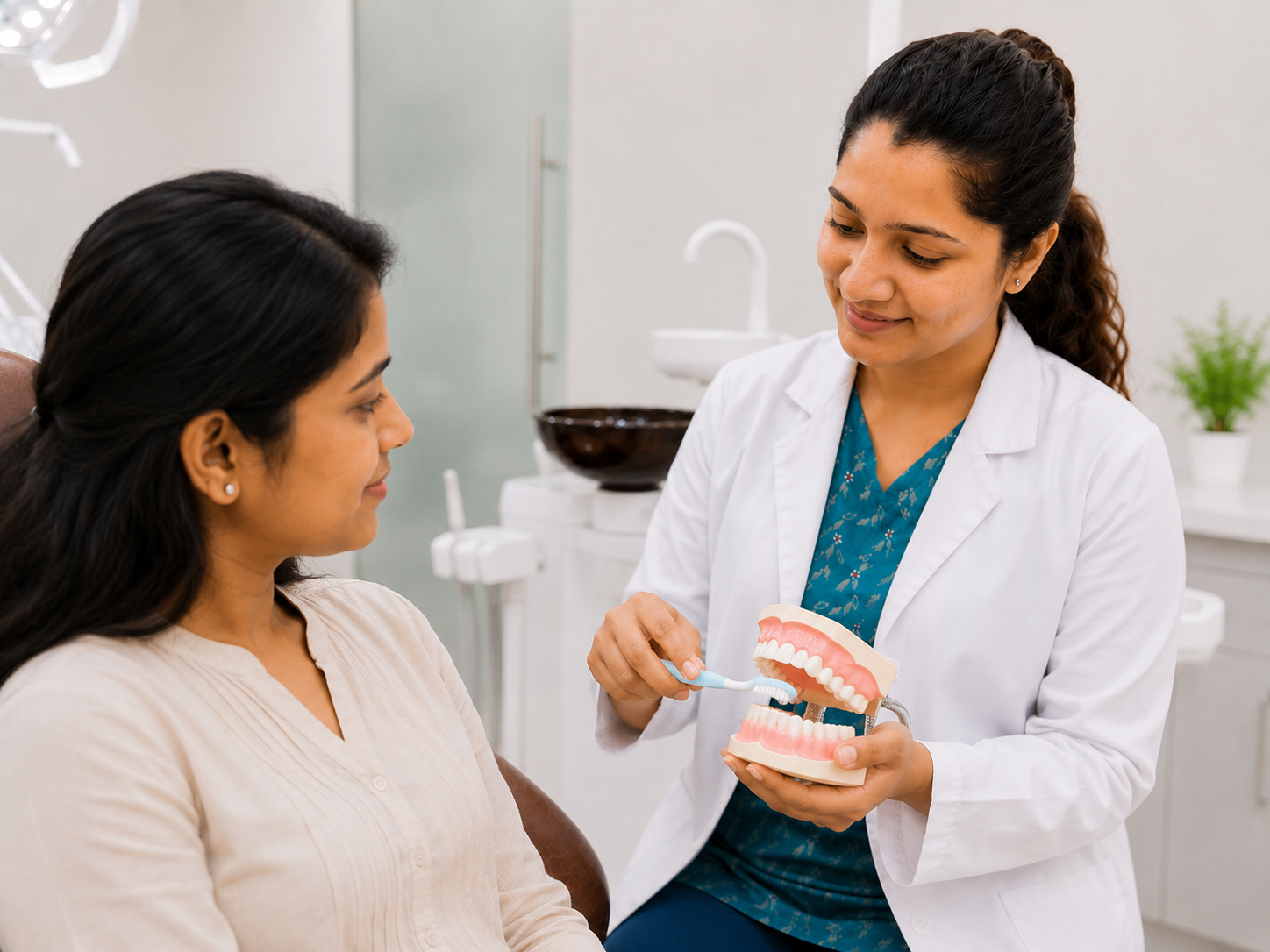
What is helping. What is hurting. Brushing technique, flossing, sugar frequency (it matters more than amount), grinding, bottle-feeding for babies — whatever applies to you.
After treatment
Daily habits that do most of the work.
- Brushing: twice a day, two minutes each time, fluoride toothpaste. Spit, do not rinse — the fluoride needs time to work.
- Between the teeth: floss or interdental brush once a day. A toothbrush misses about 30% of each tooth surface; this covers the gap.
- Sugar frequency: one chocolate after dinner is much kinder than constant grazing on biscuits. Acid attacks last 30+ minutes after each sugar exposure.
- If anything changes: a new sensitivity, gums bleeding for more than two weeks, a sore that hasn’t healed in three weeks — come in. Do not wait for the six-monthly.
The questions we hear most.
If yours isn’t here, ring or message and Dr. Sampada Khair will answer it herself.
Why is prevention worth it if my teeth feel fine?
Most dental problems don't hurt until they're advanced. A cavity is painless until it reaches the nerve. Gum disease is painless until teeth start moving. A six-monthly check catches them while they're still a small filling or a cleaning, not a root canal or an extraction.What does a preventive visit usually cost?
A routine check and clean is one of the most reasonably-priced visits at the clinic — and it usually saves you several times that in treatment costs over the years. Ring or WhatsApp +91 79000 97145 for current pricing.How often should I really come in?
For most adults: every six months. If you have well-controlled gum issues, are pregnant, smoke, or have a high decay rate, every three to four months. Healthy low-risk patients can stretch to once a year — we'll tell you which you are.Do you handle mouth ulcers and minor lesions?
Yes. Most mouth ulcers are harmless and heal in a week or two; we can suggest comfort measures. Anything that hasn't healed in two to three weeks, or any sore that feels different, gets a proper look — those are the ones worth not ignoring.What about kids?
Children benefit most from prevention. First visits from age one, six-monthly checks, sealants on the back teeth around age six and twelve, fluoride if needed, and early orthodontic checks around age seven. See the kids dentistry page for more.Do you offer night guards or sports mouthguards?
Yes. Custom-fitted night guards for grinding or clenching (cheaper to fit than to replace the worn-down teeth they prevent). Sports mouthguards moulded to your bite for contact sports.